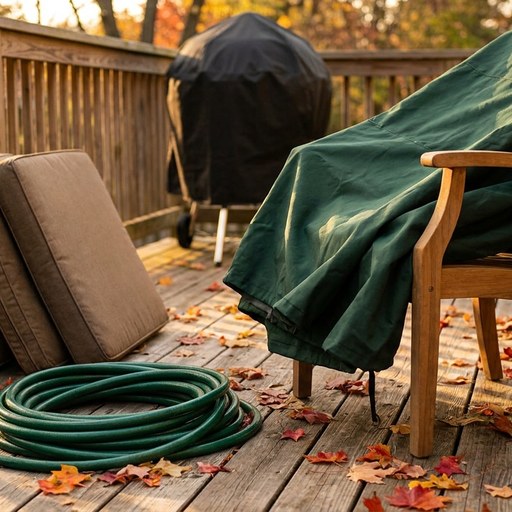
Almost nothing in a backyard is actually killed by cold. What kills it is water — water that soaked into a cushion in October and stayed there, water sitting in the bottom of a hose when the temperature drops, water that got under a furniture cover and couldn’t get back out. Freeze it and thaw it a few dozen times and it takes apart things that looked perfectly fine in September.
Which is good news, because it means the whole job is one dry afternoon of cleaning, draining and covering, done before the first hard freeze rather than after it. Here’s the order to do it in.
Furniture and cushions: clean, dry, then cover
The single most common mistake is covering something that is still damp. A waterproof cover over a wet cushion is a terrarium: it holds the moisture against the fabric all winter and you unwrap mildew in April. Wash everything with mild soap and water, rinse it, and let it sit in the sun until it is genuinely dry — not “dry to the touch,” dry through the foam. Cushions and umbrella fabric want a full sunny day.
After that, what each piece needs depends on what it is made of:
| Material | What it needs | Why |
|---|---|---|
| Aluminum | Wash, dry, cover or stack — safe to leave out | It won’t rust, but it’s light enough to become a projectile in winter wind |
| Wrought iron / steel | Touch up every chip and scratch with rust-inhibiting paint before storing | Rust starts at a scratch and spreads under the paint all winter |
| Teak and hardwood | Clean, let it dry, leave it bare — oil in spring, not now | Oil applied before a wet season feeds mildew; bare teak just weathers to grey |
| Resin wicker / all-weather | Store indoors if you can; cover if you can’t | Resin gets brittle in deep cold and the steel frame inside it rusts where the weave hides it |
| Plastic / resin chairs | Stack, strap or store — never leave loose | Cheap to replace, but they blow into cars, windows and neighbors’ yards |
| Fabric slings and cushions | Bone dry, then indoors or in a sealed deck box | Mildew is a storage problem, not a weather problem |
| Glass tabletops | Remove and store flat, off the ground | Wind plus freeze-thaw shatters tempered tops, and the shards go everywhere |
| Umbrellas | Open and dry fully, roll loosely, store inside | A rolled damp umbrella mildews from the inside out; an open one becomes a sail |
If you’re covering rather than storing, buy the cover for the job. A cheap tarp is waterproof, which sounds right and isn’t — it traps every bit of evaporating moisture underneath it. A proper patio cover is waterproof on top and vented, so air moves. Set the furniture on blocks or a couple of 2x4s first so water can’t wick up from the ground, tie or strap the cover down, and don’t cinch it so tight that air can’t circulate.
Drain and turn over anything that holds water: birdbaths, fountains, self-watering planters, unglazed ceramic pots. Water freezing inside concrete or terracotta is what cracks them, every time.
Vented patio furniture covers →
The grill: the deep clean is the winterizing
A grill put away dirty spends five months with grease and moisture sitting on steel. Grease is also the reason grills catch fire, so this is the one item on the list with a safety argument attached.
- Burn it off, then scrape it out. Run a gas grill on high for fifteen minutes with the lid down, then brush the grates. Pull the grates and the flavorizer bars or heat tents and clean underneath them.
- Empty the grease tray and the catch cup. Not “knock the worst off” — empty and wash them. Accumulated grease is the leading cause of grill fires, and it has all winter to build up a habit.
- Charcoal grills: get every ash out. Ash holds moisture against the metal and will rust a kettle from the inside. Use a metal container with a lid for the ashes — embers stay live for days.
- Oil the grates lightly with cooking oil before storing, and wipe the interior surfaces. It’s a rust barrier, and it costs nothing.
- Block the burner tubes and openings, or store the grill inside. Mice and spiders nest in Venturi tubes over winter, and a blocked tube is a spring flare-up waiting to happen. Whatever you plug them with, write yourself a note.
- Pull the igniter battery so it can’t leak in the cold, and cover the grill only once it is completely cool and dry.
Then the propane, which is the part people get genuinely wrong. Never store a propane cylinder indoors — not in the garage, not the basement, not a closed shed. A cylinder stores outside, upright, in a shaded well-ventilated spot, away from doors and dryer vents. Close the tank valve, disconnect the regulator, and cap the outlet. Cold weather doesn’t hurt a tank; an enclosed space and a leaking valve is what does.
If the grill lives outside all winter, cover it — and again, a vented grill cover rather than a tarp bungeed around it.
Hoses and anything else holding water
Water expands about nine percent when it freezes, and it does it with enough force to split a hose lengthwise and crack a brass fitting. Everything in this section is the same instruction said six ways: get the water out.
- Disconnect every hose from the spigot. This is the important one. A hose left connected holds water back inside the sillcock, and that water freezes in the pipe inside your wall. It is the most expensive five-minute job you’ll skip — the rest of that story is in winterizing outdoor faucets.
- Drain the hose properly. Stretch it downhill, or walk it over your shoulder end to end, then coil it loosely — tight coils and sharp kinks crack when the rubber is cold and stiff.
- Store it above freezing if you can, out of sunlight. UV and ozone age rubber faster than winter does; a garage corner or a hose reel in the shed beats a heap on the patio.
- Nozzles, wands and sprayers hold water too. Open them, shake them out, store them inside. Same for a garden sprayer — empty it, rinse it, and leave it open so it dries.
- Pressure washers need antifreeze, not just draining. Run pump-saver solution through the pump per the manual; a frozen pump is a dead machine, and it is the single most common way pressure washers die.
- Rain barrels: drain, disconnect from the downspout, and either store them or leave them upside down.
While you’re at it, run the mower dry or stabilize the fuel, and get the leaves off the hardscape before they mat down — wet leaves left on a deck or patio stain the surface and hold moisture in the boards all winter. That’s a separate afternoon, but it belongs to the same weekend.
While the deck is empty, actually look at it
Here’s the bonus in all this. Once every chair, planter and grill is off the deck, you can see the whole surface for the first time since spring — and it is the only honest moment to inspect it. Walk it and look for boards that are cupping or soft underfoot, popped or rusted fasteners, and the spots where the furniture feet have worn the finish through. Check the railing by leaning on it, and look at where the ledger meets the house for any sign of water staining.
Anything soft or splitting goes on the spring list, not the winter one — but knowing the board count now means you can buy in the winter lull instead of the May rush. If you’re planning to replace boards or rebuild a section, our deck calculator gives you the board and fastener counts in a couple of minutes. And if the finish is what’s tired, put staining and sealing on the calendar for a dry stretch in spring.
Cushions in a box, grill cleaned and covered, hoses drained and off the spigots, deck swept and looked at. That is the whole list, and it is genuinely one afternoon — one that buys you a spring where nothing you own has to be replaced.
Deck storage boxes for cushions →
As an Amazon Associate, Clearly earns from qualifying purchases.
Replacing deck boards in the spring?
Get the board count, the fastener count and the waste allowance before you buy — free, no signup.